Comfy cows make economic sense
At this south west Victorian dairy farm, cow comfort has always been a priority and its production figures demonstrate the payback on this decision.
Housing the cows has further intensified this focus.
Professor Ian Lean, a leading authority in the medicine, nutrition, and management of dairy cattle, is the farm’s consultant.
A former lecturer at the University of California in the US and the University of Sydney, Professor Lean remains an adjunct professor at the University of Sydney School of Life Sciences.
He instigated the purchase of the Ridgeback® barn – drawn to the innovative self-ventilating structure and how it optimises airflow.
For Professor Lean, housing dairy cows is a way the Australian industry can overcome some of its profitability constraints.
“There are several factors which change the economics, number one is that they are no longer losing energy in exercise,” he said.
“Two, it allows the cows to handle the adverse environment far better and the farm is able to grow crops that yield much more per hectare. Finally, when you are talking about pastures, you are no longer destroying 20 per cent of the pasture through cows walking, defecating, and urinating on it. In wet climates, the impact of pugging is vastly reduced.”
“We have done a number of sheds now (with clients) and they have all had very similar responses. The thing that makes me, and them, happiest is that they have happy cows. Cows that are really content.”
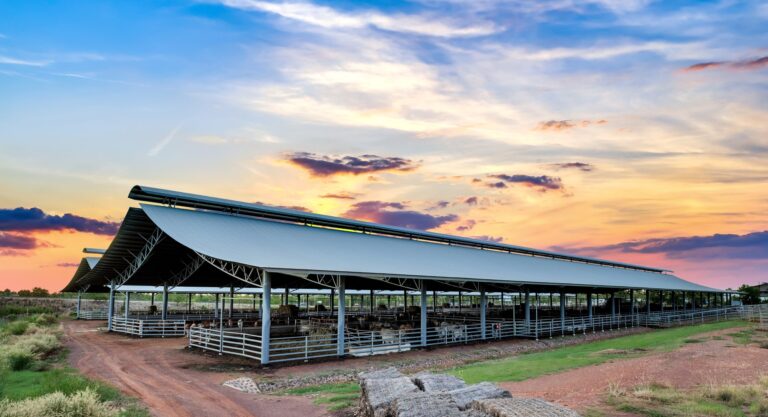
Improved ventilation is at the heart of the Ridgeback® design. The barns’ concave curved roof not only looks good, but it helps heat escape faster than a traditional straight-line shed.
Entegra studies have shown at least 20 per cent more air changes per hour inside a Ridgeback® barn – compared to traditional style sheds – because of its design.
Ridgeback® barns have housed beef cattle in the Northern Territory and dairy cattle in hotter, drier parts of the country.
Providing protection from the elements and improved ventilation reduces livestock heat stress, improves animal welfare and farm productivity.
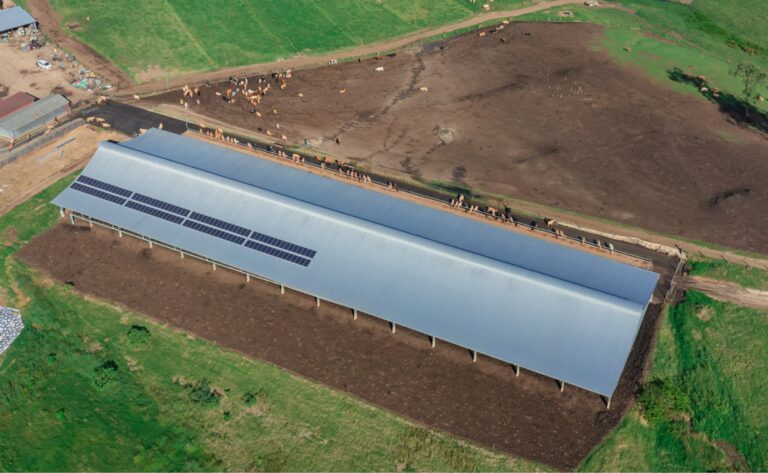
The Ridgeback® on this south west Victorian dairy farm is 6.75 metres high at its lowest point along the outside perimeter and steadily rises to 15m in the middle.
A gap of 1.6m runs the length of the roof at its highest point, this is where the heat and livestock emissions escape.
This Ridgeback® has been customised for the local conditions with a shade cloth along the west wall, covering a 5m opening along the side. This provides additional wind protection and can be moved if required.