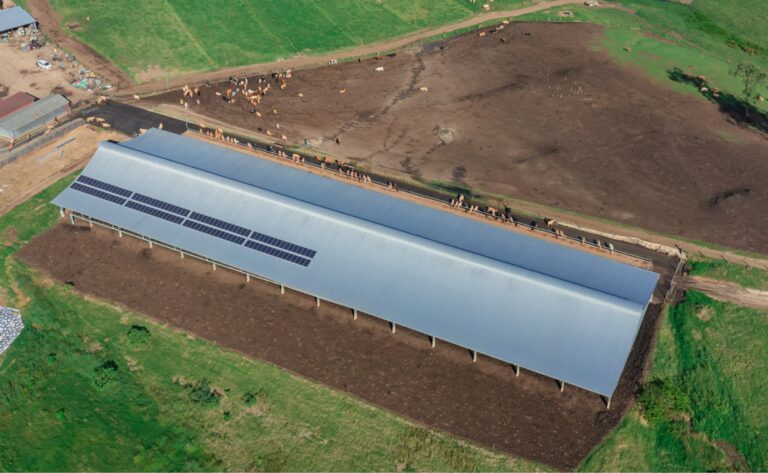
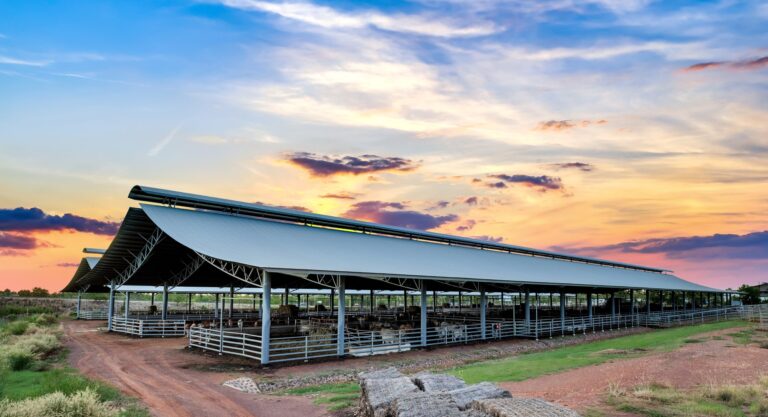
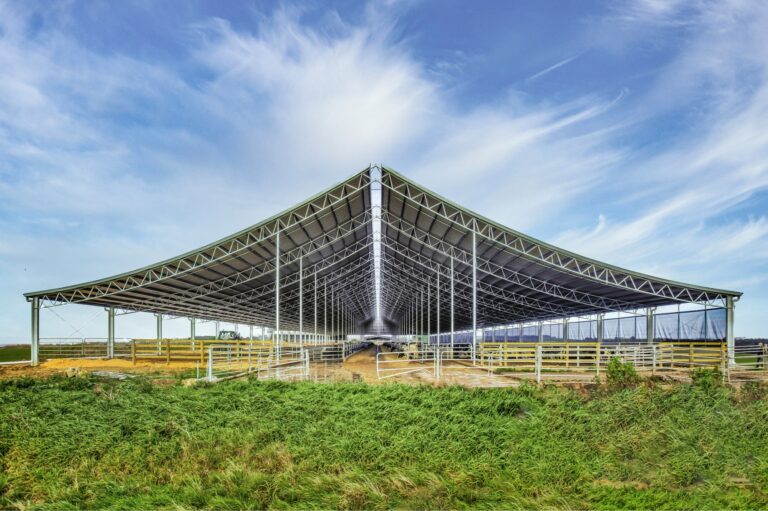
The Ridgebacks® have been instrumental in all these outcomes.
These constructions are the Shaws’ “point of difference”.
“The animals, we feel, are a lot more comfortable under a shed, for shade and shelter,” Sarah said.
“They also have environmental benefits, we capture all our water runoff and use the water. We don’t have any effluent implications and we also use deep pen litter – sawdust – to break down the effluent and that then has high value on our property when we spread it.”
Elbow Valley Beef long-fed Wagyu has been supplying meat for the past two years.
Progressively the marble-score of this beef has improved as more cattle have transferred to under Ridgebacks® .
Each pen, beneath the Ridgeback® , has been designed to ensure every animal has the easiest access to feed and water.
There’s a feed bunk and water trough at either side of the pens which means animals in the middle, only have 15 metres to walk to access either food or water.
The pen bedding is 800mm thick – a compost – and has a “sponge-factor” that delivers a level of cleanliness and comfort that’s unrivalled in an outside environment.
The comfort of the animal’s is evident each day when the younger Chris Shaw is delivering rations.
“Doing the feeding-up and in the tractor, I have a good vantage point of the cattle under the Ridgeback® sheds,” he said.
“I notice a lot of the behaviour signs that show the cattle are content and comfortable. They are always lying down, unless they are eating, and there’s lots of licking of each other which shows companionship. They are not stressed out. And even on a hot summer day, you’d rarely notice any more than a couple at the trough. They are well watered and well fed.”
It’s this stark difference between the management of cattle outside, compared to those under the shade and shelter of a Ridgeback® that’s made huge improvements to welfare, according to Jack Shaw.
“The largest point of difference between a traditional and a Ridgeback® system, from a comfort point of view, is the extremes you get seasonally,” he said. “Winter and summer. Through summer you get 40 degree days and the troughs are out in the open, they get direct sunlight and algal bloom. We try and mitigate that through trough blocks and cleaning troughs twice a week, however, there will also be a temperature rise in that water. Eight hundred kilo cattle don’t handle those sorts of environmental factors, there’s crowding and panting. However, standing underneath a Ridgeback® , with the design, there’s a constant airflow, you get a nice, cool breeze. There’s a significant difference in the maximum day time temperature.”
This same protection is also afforded to these cattle on the cold, misty and foggy winter mornings at Canning Downs South Feedlot.
The compost bedding delivers comfort and heat, when combined with the body warmth of the animals, and this keeps cattle dry and warm when the temperature dips below freezing.